 Welcome to Safety Knights!
 The community for Health and Safety Professionals. Check out today's discussions.
Welcome to Safety Knights! The community for Health and Safety Professionals. Check out today's discussions.

 Welcome to Safety Knights!
 The community for Health and Safety Professionals. Check out today's discussions.

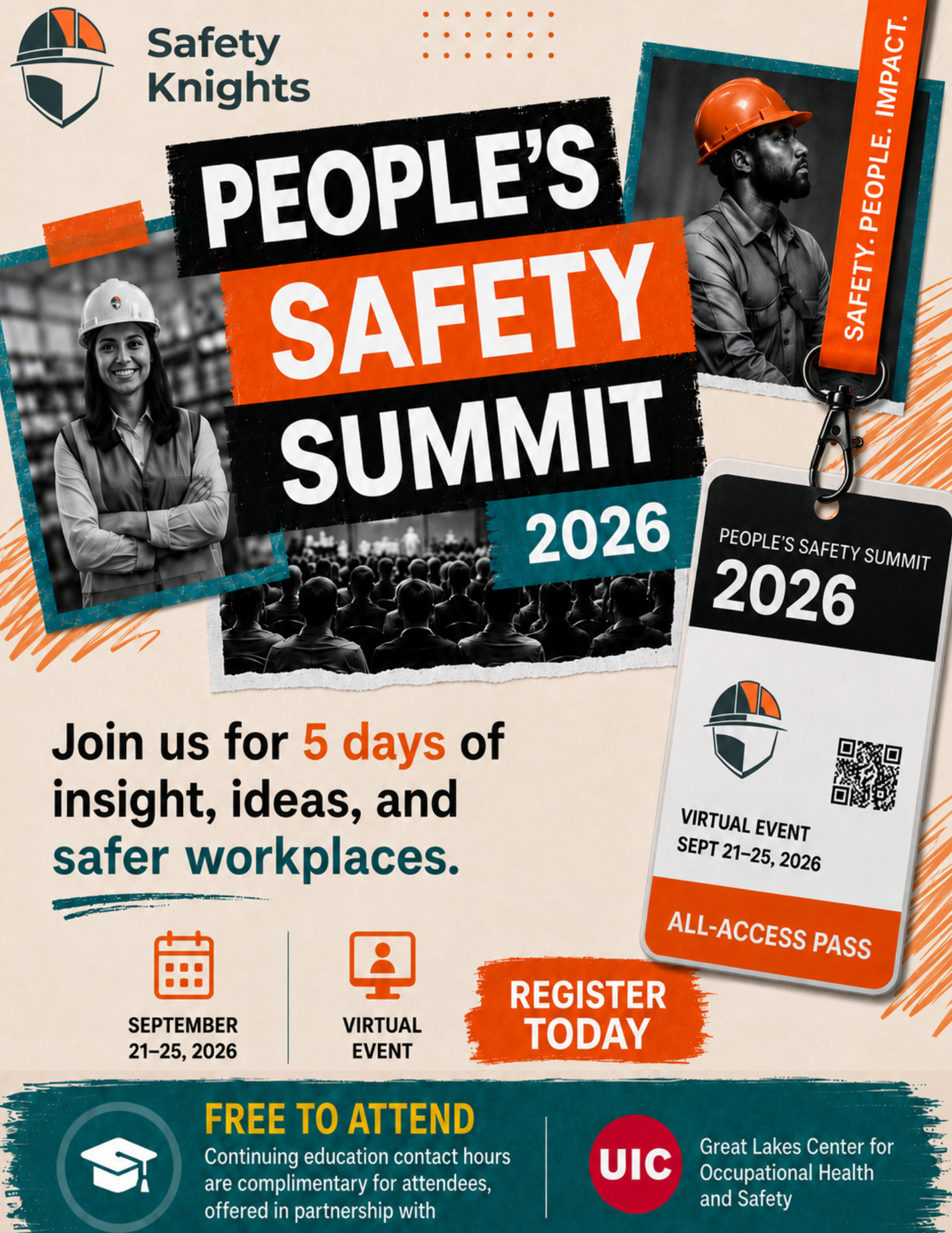
The People's Safety Summit
The People’s Safety Summit is coming September 21 through 25. Five days. Fully virtual. Completely free. Attend and earn complimentary continuing education contact hours through our partnership with the University of Illinois Chicago Great Lakes Center for Occupational Health and Safety. Already on the schedule: • Wyatt Bradbury, Avetta: Fortune Cookie Leadership: Small Lessons with Big Impact • Brandon Smith, EPSCO: Free Live Online NFPA 70E Training and Certification • TJ Armic and Arianna Howard, Syncra Group: Developing Your EHS Digital Strategy • Liam Locke: Simplifying Insurance for Safety Leaders, Management & Senior Leadership • Chris Ward, Slate Safety: Heat Safety • Lisa Krefft, 3motion: Ergonomics • Kelly Unruh, CIPSolutions: Ergonomics • Ryan Obsuzst, OK Alone: Lone Worker Safety • George Banis, Rividor: The State of Safety Through the Lens of $1 Billion in OSHA Violations • Graeham Ford-Feliz, Headcount: Naked Data, Flapping in the Wind: How to Use AI Without Exposing PII, IP, and Other Important Acronyms • Cory Sherman, Safety Systems Management: Beyond the Air Horn: Emergency Action Plans Built for the Real World And there’s more coming. What are you walking away with? • Complimentary continuing education contact hours • Free NFPA 70E training and certification • Step by step heat safety and ergonomics resources • A clear assessment of your EHS digital maturity and what to do next • How to use safety performance and insurance data to lower your cost of risk, strengthen renewals, and make a stronger case for more safety funding • Practical guidance for using AI without exposing PII, IP or sensitive data • A more useful, real world approach to emergency action planning • Ideas, tools and next steps you can actually take back to work and use And again, all of it is free. We’re still adding more speakers, sessions and resources. Click the orange Attend People’s Summit button at the top of the page to register.
BOILERS – “POTENTIAL BOMBS” AT WORK, HOME AND IN‑BETWEEN
We thank the author, Bilal Bangash, and the hseblog.com for the excellent article. https://www.hseblog.com/boiler-safety/ A good source of information to share and discuss internally. Every week I usually find several articles/reports on the internet on related tragic catastrophes. After reviewing the referenced article and other credible sources, several themes stand out. The world is experiencing a decline in mechanical integrity and operator competency. Boilers are being run harder, older, and with fewer trained operators — while critical safety devices are neglected or bypassed. This convergence is producing more explosions, fires, and fatalities: 1. Human oversight remains the dominant cause. Roughly 83% of boiler and pressure‑vessel accidents stem from low‑water conditions, improper installation or repair, operator error, or poor maintenance. NBIC data continues to show human factors as the largest contributor. 2. Mechanical integrity is deteriorating. Boiler explosions typically result from failed pressure‑relief valves, internal corrosion, or tube failures — all exacerbated by aging assets and weak inspection discipline. Even small boilers contain enormous, restrained energy; a breach can flash water to steam at ~1,600× expansion, causing catastrophic damage. 3. Aging infrastructure under harsher operating conditions. Natural‑gas and boiler‑related explosions have increased since 1990 due to urbanization, aging pipelines, and extreme weather. UNISDR reports a 15% rise in global natural‑gas explosion incidents (1990–2020). 4. Operator competency gaps are widening. Most boiler failures trace back to preventable conditions — especially low water and improper response to alarms. Many regions still allow uncertified personnel to operate high‑energy boilers. 5. Safety devices are not maintained — and often bypassed. Pressure‑relief valves, low‑water cutouts, flame‑failure interlocks, and other safeguards are frequently untested, poorly calibrated, or intentionally overridden to maintain production. 6. Regulatory enforcement is uneven. Low‑income regions account for ~70% of global natural‑gas explosion fatalities due to weaker safeguards and inspection regimes. Some datasets show boiler‑safety incidents increasing 11% year‑over‑year. Boilers are seeing more catastrophic failures due to 3 risk multipliers: 1. High stored energy in superheated water under pressure. 2. Aging fleets operating beyond design life. 3. Load‑cycling stress driven by renewables intermittency and market pressures, accelerating fatigue and corrosion. When safety culture weakens, these factors converge — turning boilers into “bombs” in workplaces, homes, and public facilities. Reflection: 1. What is our related risk today? 2. How do we ensure their safe operations? 3. Have we experienced any near misses? 4 If so, did we investigate/establish/address root cause?

Written program accessibility to employees
I am aware of the requirement that written plans and programs must be made accessible to employees who wish to view. Currently I am working with a binder system. That also means I have 5 locations equating to 9 binders. When it comes to updating, that gets a bit more cumbersome. I seen a letter of interpretation that asked if they could be made available electronically. We do not have an intranet but I was wondering if one knew 1) if it was even something possible and 2) if a poster with QR codes that directed employees to the particular written program they were looking for would be an approved method. I guarantee everyone of our employees has a cell phone and 99.9% have a smartphone. I would still have one binder at each location printed out. This is just me trying to think of an easier way of keeping them all updated and still maintaining access and compliance. Anyone have a similar situation and how do you handle it?
Accident/Injury reporting system for handbook
I am in the process of revising our safety handbook of which is getting a little stale and missing components (in my defense it was the first handbook we ever had that I quickly put together to take the place of loose leaf handouts that the previous HR consultant used.) I'm making the handbook sort of a guidebook for employees and will have separate formal written plans that are more spelled out along with a fleet safety handbook. One of the sections I am including and expanding on is reporting of accidents and injuries. I am planning on creating a more fleshed out written policy but for a handbook what would you include. Also, we normally drug test for injuries and accidents (I know a hot topic) but I know OSHA at one time changed their tune on drug testing and said for certain injuries (a small cut not being one of them.) I am trying to remember how they worded things or what the requirements were. If you drug test for injuries what criteria do you use?
WHAT IS A LIFE WORTH?
A PSRM REFLECTION FOR LEADERS: HOW MUCH IS A LIFE WORTH? RUPEES..$$$s..€€€s..£££s..PESOS..YENS..YUANS..RANDS..ETC? George Mickiewicz, 7 October 2026 Sharing my latest “philosophical & belief” reflection as I continue to read about the scores of daily tragic global industrial deaths, irreversible health injuries and other catastrophic human impacts. Life is worth everything. In my humble opinion, in Process Safety & Risk Management (PSRM), a human life should be considered to have infinite moral value—yet organizations routinely make decisions that imply – explicitly or implicitly - a finite, calculable worth. My reflection today is about confronting that contradiction and restoring moral clarity to risk decisions. 1. The Leadership Paradox In ethics, faith, and human dignity, life has infinite value. In risk matrices, cost benefit analyses, and shutdown decisions, a life is treated as quantifiable. Across ethics, economics, and safety science, the question “How much is a life worth?” appears in different forms: • Ethics & Theology: Human life has dignity, not a price. It is “incommensurable worth,” as philosophers argue. • Economics & Policy: Governments and industries assign a Value of Statistical Life (VSL) to justify regulations, typically around $5.7 million (median global estimate). • Operational Reality: Every day, leaders decide whether to shut down a unit, delay maintenance, or accept residual risk—implicitly placing a value on life. Leadership at all levels must confront this paradox honestly. Because the moment we allow cost, schedule, or convenience to outweigh safety, we have already placed a price tag on a human being. PSRM forces us to face this tension honestly. 2. The Moral Anchor Human life has dignity, not price. This is the foundation of ethical leadership, and it is the foundation of high reliability operations. “VALUING LIFE”: • Varies widely by sector, country, and socioeconomic context. • Labor markets often assign higher values because workers demand compensation for risk. • Health sectors assign slightly lower values, but still in the millions. • The variation proves one thing: the number is not moral — it is contextual. For PSRM, I offer that this means: We cannot rely solely on economic models to justify safety decisions. When leaders internalize this truth, safety stops being a compliance requirement and becomes a moral commitment. 3. The Ethical Anchor: Human Dignity The Yale Center for Faith & Culture emphasizes that human life has dignity, not price, and that dignity is rooted in the example of Jesus—who demonstrated that being present with others is central to human worth. This aligns with PSRM’s deepest principle: Every person deserves to go home safely, every day, without exception. 4. The Leadership Test A simple but profound reflective personal question for each one to ask ourselves: If the decision I make today leads to someone’s death, what would I give to undo it? If the honest answer is everything, then the only responsible path is to invest everything necessary to prevent that outcome now. This is disciplined leadership. This is PSRM at its highest level. This reframes PSRM from compliance to conscience. 5. Some Implications for Leaders and their Organizations • Never let cost-benefit analysis override moral responsibility. • Treat every risk reduction opportunity as a chance to honor human dignity. • Challenge “acceptable risk” when it feels morally unacceptable. • Make safety decisions as if life at stake belongs to someone you love. 6. Summary A life is worth everything. PSRM should also exist to ensure we act like it. Human life has dignity, not price. This is the foundation of ethical leadership, and it is the foundation of high reliability operations. When leaders internalize this truth, safety stops being a compliance requirement and becomes a moral commitment. When leaders adopt this mindset, the culture shifts. People feel protected. Operations become disciplined. And risk decisions reflect values, not just numbers. In PSRM, the worth of a life should not be measured in dollars, probabilities, or matrices. It should also be measured in the integrity of the leaders who choose to protect it.

“Can you build our safety culture?”
That question comes up in EHS interviews, and it carries a bigger responsibility than some companies realize. The conversation moves beyond technical knowledge into how you lead, influence people, and earn their trust. Those are fair questions. But there should be a question coming back across the table: “Will your leadership team consistently support it?” As safety professionals, we can build the foundation. We can establish expectations, provide training, listen to concerns, and help people work through problems. But culture takes shape through what people experience every day. What leaders support. What supervisors allow. What happens when someone raises a concern or stops a job. You can require compliance. Earning commitment takes more work. It also takes time. Hiring a safety professional does not mean the culture changes overnight. Leadership has to demonstrate the same commitment it expects from the workforce, especially when schedules get tight and doing the right thing becomes inconvenient. And pay attention to the people who push back. Talk to them. Find out why. Have they seen programs come and go? Have their concerns been ignored? Does the procedure make sense for the work they actually do? Some of those employees already have something you are still building: the trust of their coworkers. Their perspective can help you improve the program. When you earn their support, that influence can help others see safety differently. Support that ownership. Recognize their commitment. Give them a voice. And remember the people who already believe in what you are doing. They deserve your attention and support, too. A safety professional can help a company build its culture. But leadership and the workforce have to take ownership of it for it to last.

Notice of Resignation
Just curious for those that have done this, how have you done it? I am debating in-person to my managers vs. in email to my managers...

Overdose Response at Work: Is Your Company Ready?
A new OSHA recommendation is challenging a long-standing assumption about workplace medication policies. The agency now advises employers to consider keeping naloxone or nalmefene on hand for overdose emergencies—a notable shift that immediately caught my attention. What makes that recommendation especially striking is how sharply it contrasts with the guidance employers received just two decades ago. The HR manager in me still remembers a firm directive from Corporate Legal covering all 300 of our U.S. locations: Employees could not be provided aspirin, Tylenol, cold medicine, or any other over-the-counter or prescription drug unless it was administered by a medical doctor, registered nurse, or—in an emergency—an EMT. Even employees trained in first aid or serving as first responders could not administer medication. The directive sparked considerable debate because some plants had stocked common medications for years, and a few even kept epinephrine auto-injectors for their first-aid teams. My plant was largely unaffected because we had never provided medications. Against that backdrop, OSHA’s current recommendation represents a significant change in approach. Curious about what that could mean in practice, I did some research. Naloxone is sold under several brand names, including Narcan, and certain naloxone nasal sprays are available without a prescription; other formulations remain prescription-only. OSHA states that overdose-reversal medications generally have no effect on someone who has not taken opioids. Because their effects are temporary, anyone administering naloxone should call 911 immediately and remain with the person until emergency responders arrive; additional doses may be needed. Nalmefene, however, raises different questions. I am not a medical professional, and my pharmacological training is limited. Based on what I found, current nalmefene products require a prescription and may cause adverse effects, including acute withdrawal in people who are physically dependent on opioids. FDA describes nalmefene nasal spray as intended for health care and community settings, while OSHA notes that nasal-spray overdose-reversal medications do not require special training. For employers, the practical questions are which product to stock, who should be trained and authorized to use it, and what emergency-response procedures should accompany its use. I would recommend seeking advice from a Medical doctor before making any decisions on any administering drugs to employees. I retired from my former corporation in 2017, so I cannot speak to its current policy—but I suspect its legal team is weighing this guidance carefully. OSHA’s recommendation raises pressing questions for every employer: Should your organization stock one or both of these medications, who should be authorized to administer them, and what training and emergency-response protocols should be in place? Where do you stand? https://content.govdelivery.com/accounts/USDOL/bulletins/42c5ad7

Overdose Response at Work: Is Your Company Ready?
A new OSHA recommendation is challenging a long-standing assumption about workplace medication policies. The agency now advises employers to consider keeping naloxone or nalmefene on hand for overdose emergencies—a notable shift that immediately caught my attention. What makes that recommendation especially striking is how sharply it contrasts with the guidance employers received just two decades ago. The HR manager in me still remembers a firm directive from Corporate Legal covering all 300 of our U.S. locations: Employees could not be provided aspirin, Tylenol, cold medicine, or any other over-the-counter or prescription drug unless it was administered by a medical doctor, registered nurse, or—in an emergency—an EMT. Even employees trained in first aid or serving as first responders could not administer medication. The directive sparked considerable debate because some plants had stocked common medications for years, and a few even kept epinephrine auto-injectors for their first-aid teams. My plant was largely unaffected because we had never provided medications. Against that backdrop, OSHA’s current recommendation represents a significant change in approach. Curious about what that could mean in practice, I did some research. Naloxone is sold under several brand names, including Narcan, and certain naloxone nasal sprays are available without a prescription; other formulations remain prescription-only. OSHA states that overdose-reversal medications generally have no effect on someone who has not taken opioids. Because their effects are temporary, anyone administering naloxone should call 911 immediately and remain with the person until emergency responders arrive; additional doses may be needed. Nalmefene, however, raises different questions. I am not a medical professional, and my pharmacological training is limited. Based on what I found, current nalmefene products require a prescription and may cause adverse effects, including acute withdrawal in people who are physically dependent on opioids. FDA describes nalmefene nasal spray as intended for health care and community settings, while OSHA notes that nasal-spray overdose-reversal medications do not require special training. For employers, the practical questions are which product to stock, who should be trained and authorized to use it, and what emergency-response procedures should accompany its use. I would recommend seeking advice from a Medical doctor before making any decisions on any administering drugs to employees. I retired from my former corporation in 2017, so I cannot speak to its current policy—but I suspect its legal team is weighing this guidance carefully. OSHA’s recommendation raises pressing questions for every employer: Should your organization stock one or both of these medications, who should be authorized to administer them, and what training and emergency-response protocols should be in place? Where do you stand? https://content.govdelivery.com/accounts/USDOL/bulletins/42c5ad7

2016 OSHA’s Top 10 Most Frequently Cited Violations
We are very grateful to NOVARA for publishing this value‑adding information and for including historical data back to 2019. OSHA’s Top 3 Violations #1. Fall Protection Fall protection remains OSHA’s most cited violation for the 15th consecutive year, with 4,041 violations. In 2024, the U.S. recorded 844 fatal falls, making falls the leading cause of death in construction. Employers continue to miss basic requirements such as guardrails, fall‑arrest systems, safe ladder use, and scaffold controls. Competency gaps persist—Fall Prevention Training ranked eighth on OSHA’s list, underscoring the need for stronger worker education and enforcement. Bottom line: Fall protection must be planned, provided, and enforced with discipline. #2. Hazard Communication Chemical hazards caused approximately one worker death per week in 2024. Violations of the Hazard Communication Standard (HCS) typically stem from missing or incorrect labels, incomplete chemical inventories, and failure to obtain or maintain SDS. Roofing contractors are frequently cited due to varied chemical use and the common oversight of not having SDS available on site. As NSC notes, “The standard workers know least is the one they meet every shift—every label, SDS, and training gap is a chemical exposure waiting to happen.” Bottom line: Effective chemical management requires accurate documentation, accessible SDS, and consistent training. #3. Lockout/Tagout Many organizations have LOTO procedures, but inconsistent training and confusion over “authorized employee” qualifications lead to recurring violations. In 2024, 44 workers died after being struck by powered equipment during maintenance, cleaning, or testing, and 130 workers died from electrical exposure. NSC summarizes the stakes clearly: “LOTO is the standard whose absence shows up in the coroner’s report.” Bottom line: LOTO must be a daily operational discipline—not a forgotten binder. How to Avoid OSHA’s Top Citations A robust safety program should include: Written Safety Programs – Maintain and annually update programs for all relevant hazards. In‑Depth Safety Training – Provide new‑hire and annual training on fall hazards, chemicals, machinery, and site‑specific risks. Periodic Jobsite Inspections – Identify hazards proactively and correct issues before incidents occur. Safe Tools and Equipment – Ensure tools are inspected, maintained, and safe for use. Personal Protective Equipment – Supply and enforce proper PPE, including fall arrest systems, hard hats, respirators, and hearing protection. Strengthening these fundamentals is the most effective way to protect workers, reduce serious injuries and fatalities, and avoid costly OSHA citations. https://novara.com/blog/oshas-top-10-most-frequently-cited-violations-of-2026/
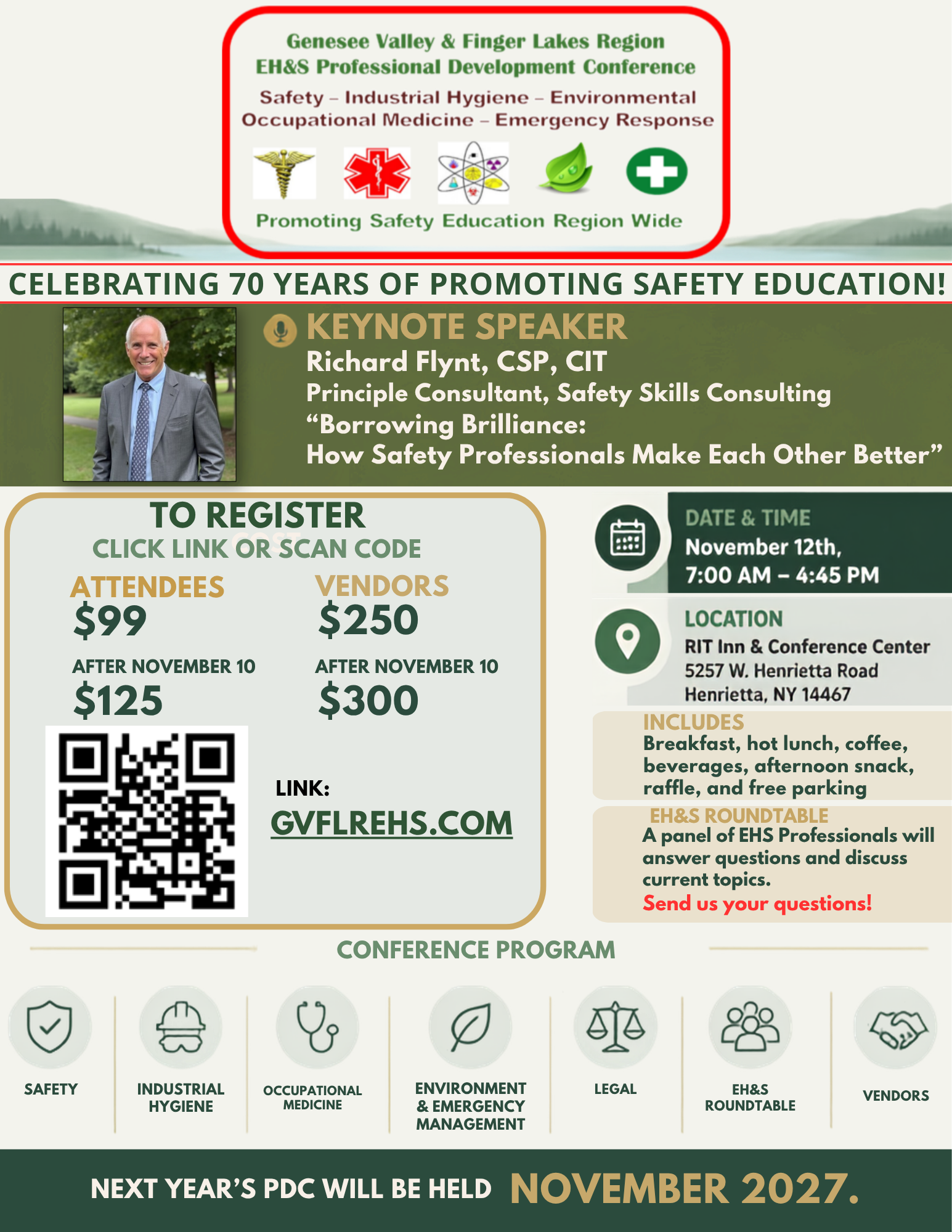
Join us for the Genesee Valley & Finger Lakes Region EH&S Professional Development Conference!
Please join us in November at the RIT Inn & Conference Center (Henrietta, NY) for the best bang for your buck conference you can find! https://www.gvflrehs.com/

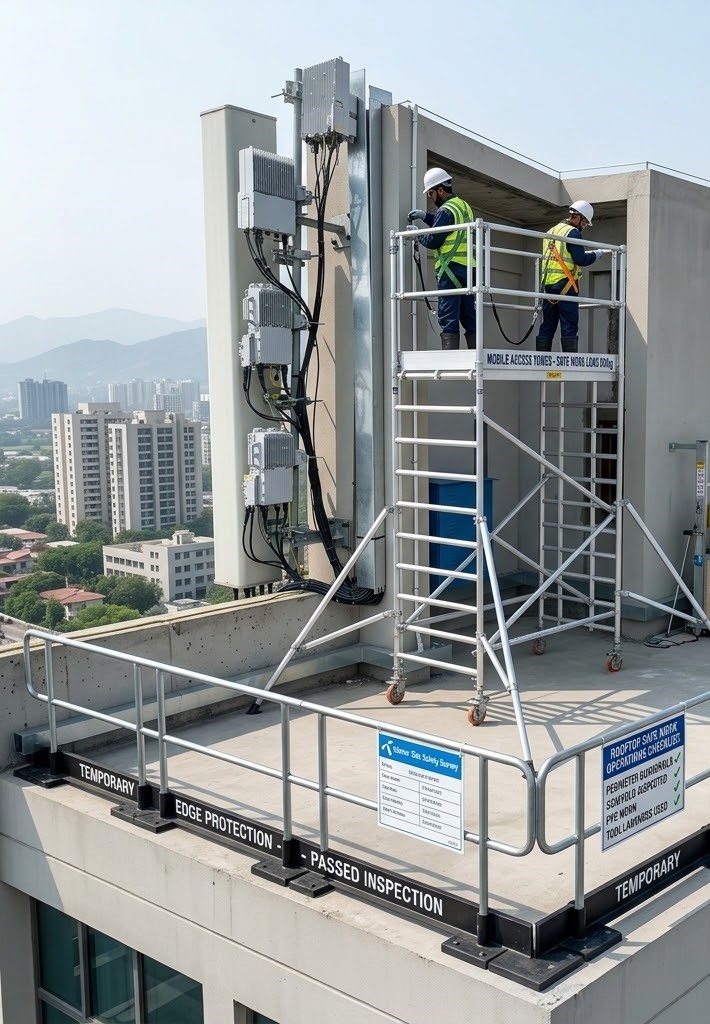
Working At Height Solution
Hi All, I am exploring solutions to ensure safe work at height for equipment maintenance at about 120-150 ft above ground level. The provided image is a reference image which is AI-generated. It should be something mobile, practical, and cost-effective. Thank you.

New to Water Utilities Industry
Hey fellow Knights, I’m excited to share that I’ll be moving into a Director of Occupational Health, Safety & Facilities role with a privately owned and managed public water supply, distribution, and treatment company. My EHS background has largely been in manufacturing, laboratories, chemical processing, and warehouse distribution, so I’m eager to learn the water utility world from those who know it from the inside. If anyone here works in public water, wastewater, or related utility operations, I’d really appreciate connecting. I’d also welcome any recommended resources, associations, training, or lessons learned; especially around safety culture, emergency response, contractor management, fleet/DOT exposure, and treatment or distribution system hazards. Currently i am leaning on AWWA resources that seem helpful. Looking forward to learning from the community and bringing that perspective into this next chapter.
Career Shift
Would be curious to hear everyone's thoughts on a new potential opportunity that I am being recruited for. It's a hybrid role, something I've not yet done in my career thus far. I currently work in a heavily regulated, government contracts manufacturer. I lead a team of 10 professionals with breadth and depth. My commute is 40 minutes to the plant. Security is very tight and outside connections are limited and though not overly bothersome, it is inconvenient. The work is fulfilling and serves a great mission, but the regulatory oversight and high-consequence environment is non stop work and stress. The new opportunity would be a completely different role, a regional safety manager for a healthcare company. It's a hybrid role and the travel is one or two times a month for a day or two at a site. The region spans 3 or 4 states. A former boss who is at this company is trying to get me to join as a peer. We worked extremely well together in the past and routinely keep in touch. Also, the salary would be a massive upgrade. Benefits and such seem to be fairly close to what I have at my current employer. The company seems stable and has a good reputation. So far, I think it would be foolish not to pursue at this point since they are recruiting me. Appreciate any insights!!
Culture! What is it?
An interesting question to begin with, we all have an internal concept of what workplace culture is, how would you describe it? And another question or two. Is is subjective? Doest it have more that one macrosystem? Is it realistically measurable and finally can it be different for each individual within the workplace?
PRCS - Alternate Procedures and Lockout?
I recently was drafting a report to a customer on the use of Alternate Procedures in Permit Required Confined Space. In a section of the report, I was discussing the mechanical hazards in one of their spaces. OSHA 1910 would require those spaces to be locked out as they are not guarded, and it would be difficult to do so in entry. Because of an OSHA Letter of Interpretation of October 12,1995, OSHA interprets 1910.146(c)(5) on the use of Lockout and Alternate Procedures. This of the standard says to use Alternate Procedures you must recognize: "If the space poses other [than atmospheric] hazards as well, either all the hazards must be eliminated” Basically, the rest of the letter says that “all” really means ALL hazards other than atmospheric must be eliminated. In addition, OSHA does not consider lockout to be elimination of a hazard, but a control of a hazard. Therefore, OSHA says you cannot merely perform lockout on hazards to implement Alternate Procedures and must use full PRCS. My customer really would like to use Alternate Procedures in entry of this space. Since this OSHA letter was written almost 31 years ago, has anyone come up with a practical, temporary, and legal method to “eliminate” a mechanical hazard in a space to facilitate Alternate Procedure Entry? The Letter is here: https://www.osha.gov/laws-regs/standardinterpretations/1995-10-12-0
Authorized OSHA Outreach Again?
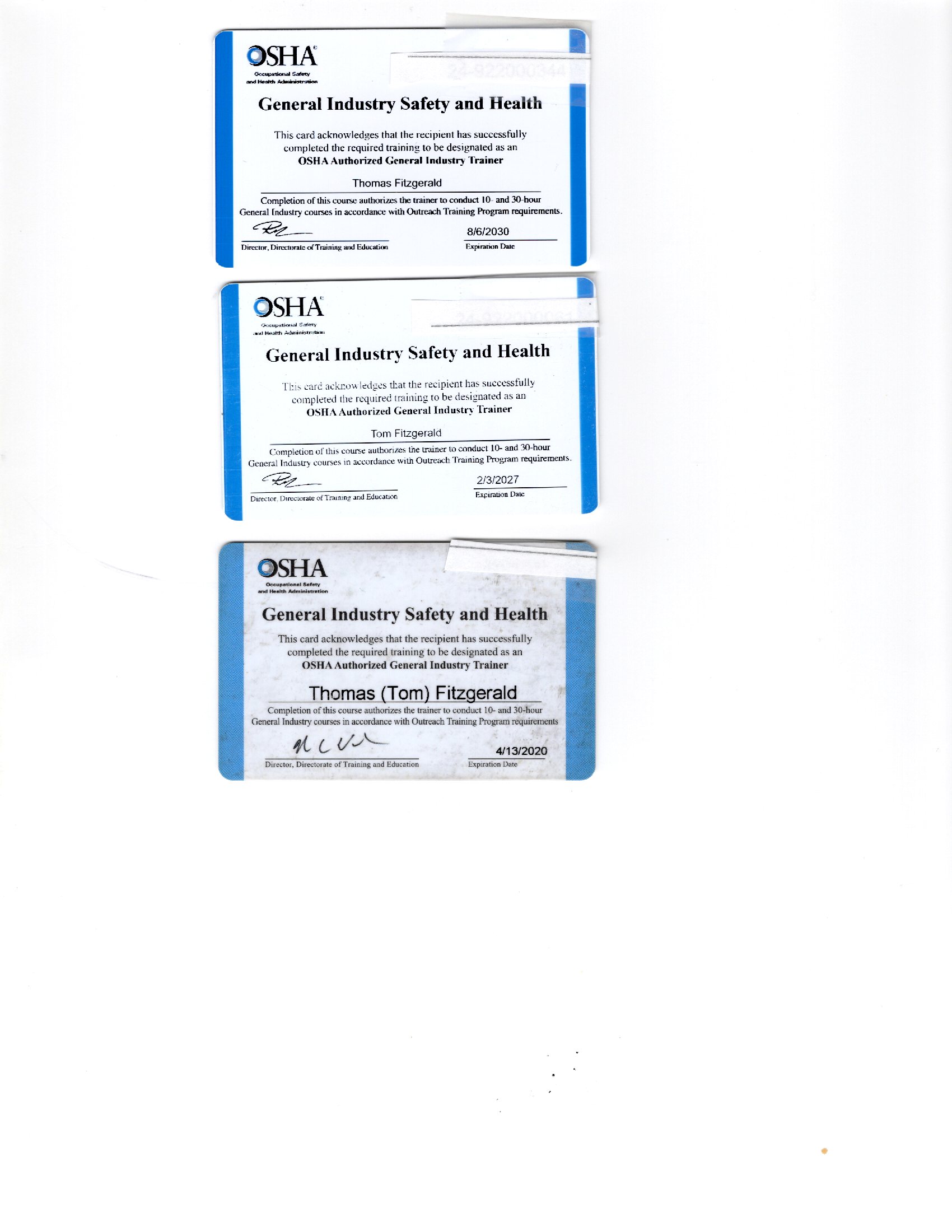
I have been an OSHA “Authorized” Outreach Instructor for General Industry since completing OSHA 501 in 2012. Since then, I have taught more than fifty 10-Hour and 30-Hour courses, mostly in classroom settings, with about a half-dozen delivered online during COVID. My fourth OSHA Authorized Trainer card expires in February 2027, and I struggled with whether to take OSHA 503 for the fourth time to remain authorized. Here are my reasons: 1. At 72, I know I am closer to the end of my teaching career then the beginning. I am not sure when I will finally retire for good—or when the Big Foundryman in the Sky may call me up to the Big Foundry in the Sky, where no one gets hurt and there is no scrap! 2. There does not seem to be as much demand for this training anymore. I used to teach five to eight classes a year; now it is usually one or two. The issue does not seem to be the cost of bringing me in. It seems to be the challenge of taking valuable people away from their jobs for 10 or 30 hours. 3. The OSHA 503 “re-up” class takes three full days, and my OSHA ATO (Authorized Training Organization) offers it only twice a year in a classroom at a technical college 40 miles away in Green Bay. The last class before my card expires was three weeks ago. 4. I took OSHA 503 online in 2023, and it was not a valuable experience for me. There were forty people in the class, and I did not come away with much that felt new. After fifty years in safety, there is not much that feels new anymore—except technology and AI. 5. I am an old foundry supervisor, and I know my style can be blunt. I also know I come from a Baby Boomer mindset. Recently, I taught a class with salespeople who had never actually been in a factory, and it was a tough experience for all of us. They could not always connect with my examples, and I could not always connect with their frame of reference. In another class, I said, “Not using lockout when you should is like playing Russian roulette.” A couple of weeks later, I received a call saying a student took the comment very badly because they were of Russian descent. Experiences like that made me wonder whether I need to keep adapting how I explain safety to different audiences. On the plus side: 1. I found a niche in emphasizing Hazard Recognition and Remediation (HRR + risk assessment), especially for supervisors. My smaller customers have found real value in this training, and it has become my model for the past couple of years. 2. I love teaching it, and despite point #5 above, I know I still do a great job and have “gas” in the tank! Well, my mom used to say, “In for a penny, out for a pound.” So, I went ahead and took my fourth OSHA 503 class three weeks ago. I am glad I did. I met six new safety professionals I had not known before, and I learned a couple of new things. That is never a waste. Now I am good until early 2030. Hopefully, the Big Foundryman will not call me up until after that! How about you? Have you had similar experiences with renewing training credentials, adapting to new audiences, or deciding when it is time to step back? PS I have been in Canada fishing for the last week and a half with my grandsons and before that have been busy with Safety training and the above, so have not been on in a while. I am back!
Exit Routes
Looking for a 3rd or 5th opinion from someone who's been in the business a little longer than I have. I work in an injection molding facility. Do we have to have 2 exit routes from every machine or is it 2+ exits from the facility? And does an aisle that you can turn left or right to get away from the machine count as 2 routes or 1? Thanks in advance for the opinions!
Reducing Responder-Involved Crashes
Summary of the Effect of Emergency Vehicle Lighting, Marking, and Message/Arrow Boards in Reducing Responder-Involved Crashes: Systematic Literature Review and National Level Survey. If you want a copy of my summary please contact me, I will gladly share! Just put "Summary of the Effect of Emergency Vehicle Lighting" in the subject line and I will email you a copy!
FREE Webinar with Korey Stringer Insitute CEO Dr. Casa
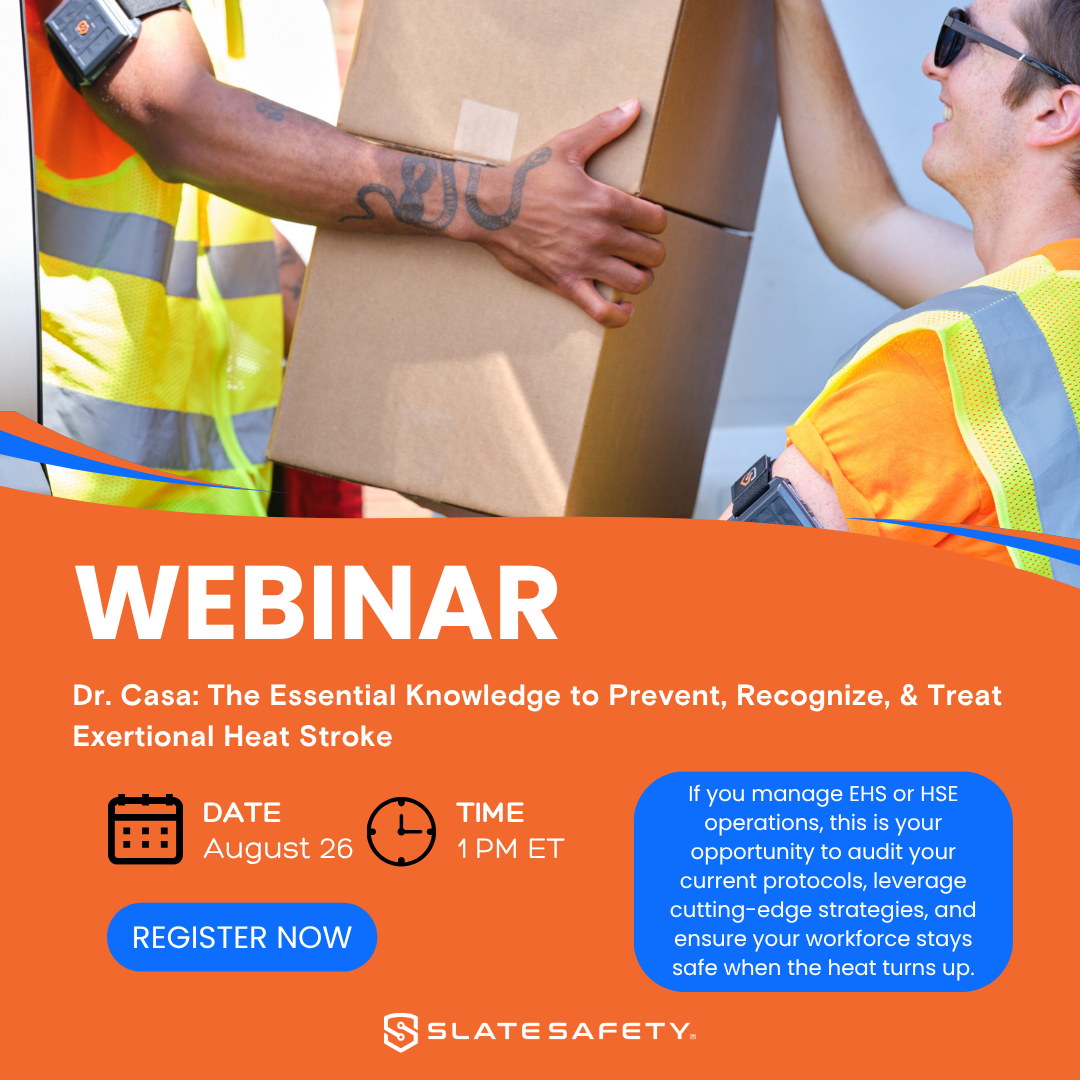
SlateSafety is hosting a webinar tomorrow, 8/26 at 1 p.m. with speaker Dr. Douglas Casa. Title: The Essential Knowledge to Prevent, Recognize, & Treat Exertional Heat Stroke. If you manage EHS or HSE operations, this is your opportunity to audit your current protocols, leverage cutting-edge strategies, and ensure your workforce stays safe when the heat turns up. Can't make it? Register anyway for access to the replay. Register: https://crowdcast.io/c/7qrommry6oxy
Assistant Safety Manager Position at Adolfson & Peterson
Apply here: https://www.linkedin.com/jobs/view/4449313342/ We build trust among our communities and our people by cultivating the right team for every job. We are committed to fostering a creative and collaborative culture with a focus on career growth and balance in the workplace. AP has diligently built a strong foundation of expertise, experience and exceptional results. We continually invest in our talented team by providing the latest tools, technologies and training necessary to stay ahead of the curve. We set our employees up for long-term success through mentorship opportunities and professional growth and advancement for every person in every role. We recognize the contributions of our team members with unique experiences and capabilities and strive to establish a work environment that maximizes our collective potential. Going beyond the build for our employees lays a strong foundation for success across AP. We commit to a balanced, value-centered work environment for meaningful projects, careers and talent. Job Description: Adolfson and Peterson Construction is currently hiring for an Assistant Safety Manager for our Midwest Region based out of Minneapolis. Will role will manage AP’s safety program to ensure a safe environment for all team members. Champion the Incident and Injury Free (IIF) philosophy and culture in a manner that supports senior managements’ commitment operate in a manner that fosters and supports the IIF initiative. Provide safety trainings and communicate safety issues. This position may be responsible for a region’s safety program or be assigned specifically to designated projects. Responsibilities: Take personal responsibility for working safely within an Incident and Injury Free (IIF) culture Be a champion to support IIF efforts for working safely and building a culture of care and concern for each team member in the workplace. Consistently communicate and reinforce the tenets of an IIF workplace. Ensure adherence to processes and procedures that support an IIF culture. Comply with all company safety requirements and policies. Collaborate with other team members to implement and support the development of site-specific safety programs. Maintain a program that encourages safe behavior for all site team members and reinforces the achievement of safety goals and objectives. Recognize and recommend compliance-based safety and health training opportunities. In collaboration with site specific safety professionals, utilize learning management system to identify and assign appropriate training topics. Further the safety education of all project site team members whether by formal classes, seminars, workshops, or situational and spontaneous coaching Ensure regional SDS inventory is accurate and assist in any modifications to the Health and Safety Manual. Monitor site safety communications to maintain training effectiveness (signage, toolbox talks, site safety committee meetings, etc.). Manage the safety program on assigned projects in accordance with organization-wide requirements and best practices. Ensure compliance with policies and practices that result in employee behavior that reinforces AP senior management’s commitment to IIF. Conduct the safety training program in accordance with all organizational standards, practices, and policies. Provide safety and health training to all AP management and supervisory personnel. Distribute new and changing safety related information and provide training when necessary. Lead and monitor multiple project’s safety program and communicate findings to senior management and project team members. Perform safety inspections on projects at a designated frequency. Instruct and train field team members in the recognition and avoidance of unsafe practices and conditions to eliminate hazards. Coordinate consultation efforts with OSHA and implement corrective actions identified during OSHA consultation walks. Ensure compliance with corporate, State, and Federal regulations and guidelines regarding to occupational safety & health. Work closely with Superintendents, Project Managers, Subcontractors, and Owners to ensure compliance with various safety polices. Assist in the development of safety plans for high risk/unique work. Identify areas of deficiency or trends and communicate to project management for several project sites. Generate region's quarterly reports on identified safety trends. In coordination with leadership, provide assistance for regional worker’s compensation needs. Provide effective communication with onsite safety personnel to ensure injuries are managed appropriately (return to work, light duty, etc.). Work with the Regional Safety Director and Safety Manager to identify light duty and other work that injured team members can perform. Conduct formal investigations in work related incidents to determine cause and corrective actions - work with regional director and manager on implementation. Monitor the return-to-work process for injured team members to minimize the impact of an injured team member returning to a jobsite. Other duties as assigned. Requirements: History of experience and proven results including: Two-year degree or a bachelor’s degree in industrial safety, safety management, or related field. 5+years in a title construction safety role. Experience working through inspections and audits with state and local government agencies. Proficiency with Microsoft Office including Word and Excel. OSHA 30 Certification preferred. Currently possess or able to obtain OSHA 500 Trainer Card for the construction industry. First Aid/CPR/AED Certification ASP (Associate Safety Professional) certificate or ability to obtain within the first year of employment. Competent in the following areas: excavation, trenching, fall protection, confined space, silica and scaffolding, rigging & signaling. Proficient knowledge of EHS standards, industry regulatory standards in construction, with the ability to communicate such standards to others. Ability and willingness to travel. Willingness to work in various (sometimes extreme) climate conditions. Demonstrated integrity and ethical standards. Developed skills (written, oral, and listening) to effectively communicate with diverse audiences. Experience in a complex business as an active participant in driving growth and change; demonstrated effectiveness in driving operations and executing plans Experience cultivating an active network of relationships, driving collaboration and alignment, relating well to colleagues, and connecting with employees at all levels. Ability to drive to the core of complex issues and provide insightful and constructive feedback. Estimated Pay: $78,000.00 - $124,000.00 Benefits: Medical, Dental, Vision and Life Insurance Health Savings Account 401(k) Flexible Spending Accounts (Dependent & Medical Reimbursement) Paid Time Off (PTO) and Holidays Tuition Assistance Program Employee Referral Bonus Adolfson & Peterson Construction’s (AP) ability to adapt and innovate has driven our success for more than 80 years. We are consistently ranked among the top construction managers and general contractors in the nation while maintaining one of the safest records in the industry. We bring positive and measurable change to the communities where we live, work and build. And we invest in new processes and technology to be operationally excellent and remain at the forefront of the ever-changing industry. We have been committed to quality, innovation, safety and strong relationships since our beginning in 1946. AP offers preconstruction, construction and contracting services to commercial, education, healthcare, hospitality, industrial, multifamily, municipal, data center, and senior living markets with offices across Arizona, Colorado, Minnesota, North Dakota, Texas, and Wyoming. We employ more than 850 team members who strive for excellence and embody loyalty, trust and genuine love for what they do. We go beyond the build for our communities and our people. Adolfson & Peterson Construction is an Equal Employment Opportunity Employer